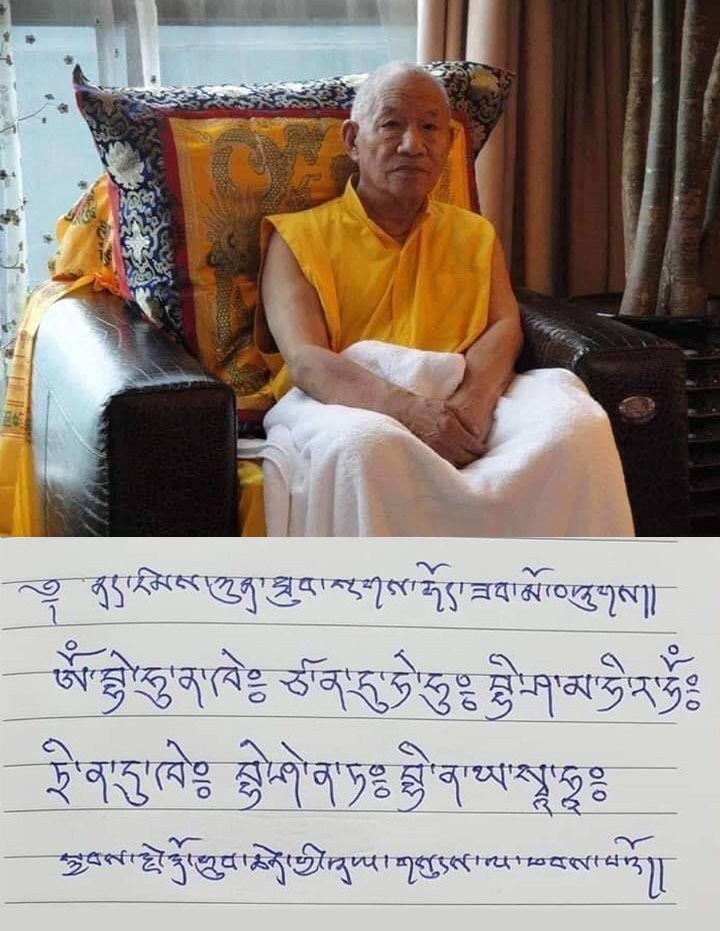
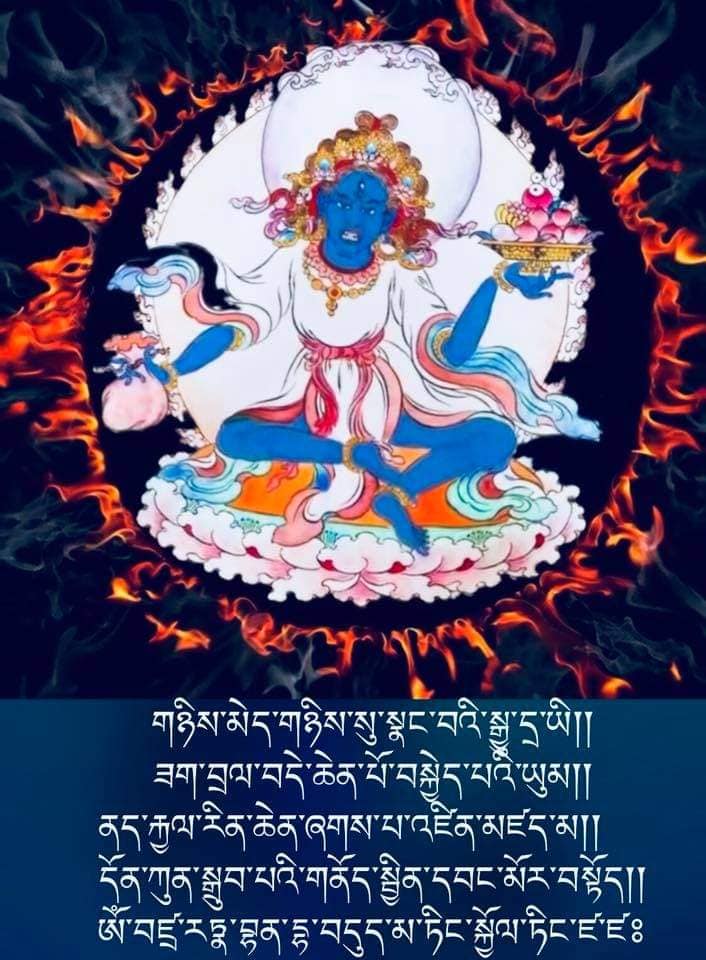
Tangtong Gyalpo’s Prayer to the Jowo Rinpoche Statue

Posted in Translations from Tibetan, buddhism, buddhist scriptures, tibetan buddhism, tibetan language, translations on July 10, 2009 by sherabzangpo

Tangtong Gyalpo’s Prayer to the Jowo Rinpoche Statue:

The Lord Mahasiddha’s Prayer Performed Before the Jowo Rinpoche Statue of Lhasa


T’HA YAY DRO WA NGEY PAR DROEL LAY DU

In order to definitively free the limitless sentient beings,

LA MEY JANG CHHUB CHHOG TU THUK KYEY NAY

you generated the exalted mind bent towards supreme and unsurpassable awakening;

TS’HOK NYIY DZOK DZAY GYAL WA T’HUK JEY CHEN

Victorious One who has consummated the two accumulations, you of vast compassion,

GOEN MEY NYIK MAY DRO LA TSER GONG NAY

consider, out of love, protectorless and degenerate living beings,

TREY KOM NYAM T’HAK DUK NGEL GYIY ZIR WAY

tormented by hunger, thirst, weariness, and suffering,

LUE CHEN DI DAK NGEY PAR KYAB CHHIR DU

and for the sake of absolutely protecting all those with bodies,

RIN CHHEN ZAY NOR DRU DANG MAL CHHA SOK

send down precious substances, food, treasures, grain, bedding, and so on,

YI ONG DOE DU’I LONG CHOE JI NYEY KYI

whatever delightfully pleasing enjoyments that are desired,

CHHAR PA DZAM LING KHA WA CHEN DU P’HOB

all in a great rain, to the Land of Snows and the whole world!

DUE MIN LUNG DANG MI T’HUN CHHAR CHHU SOK

May untimely winds, fires, rains, floods, and so on,

JUNG ZHI’I NOE PA NYE WAR ZHI WA DANG

and all harm that comes from the elements be thoroughly pacified,

DRU CHUE TSI T’HOK LO TOK LA SOK PA

and may grains, herbs, plants, crops, and the others ripen and bloom

DZOK DEN DUE TAR MIN CHING GYAY GYUR CHIK

just like the Golden Age of Perfection!

JAM DANG NYING JEY SHUK KYIY RAB KUL NAY

By means of the strength of your love and compassion, through this sublime invokation,

GYA CHHEN MOEN LAM TAB PA DI YI T’HUE

through the extraordinary power of praying in this extensive way,

NAY TSH’OEN MA GEY KAL WA NYER ZHI NAY

may this age of disease, weapons, and famine be pacified in its totality,

TSH’EY RING NAY MEY DEY KYI DEN PAR SHOK

and may we be endowed with long life, freedom from illness, and bliss and happiness!

GYAL WA SRAY DANG CHAY PAY T’HUK JEY DANG
 
Through the vast compassion of the Victorious Ones and their Heirs,

LAY DRAY LU WA MEY PAY DEN TOB KYIY

and through the force of infallible cause-and-effect,

GYAL WAY TEN PA DAR ZHING GYAY PA DANG

may the teachings of the Victorious One spread and flourish,

DRO WA KUN LA MEY JANG CHHUB NYUR T’HOB SHOK

and may all beings quickly attain unexcelled awakening!

Thus, these words were spoken in the context of a time of when Tibet and Kham were experiencing great hardships. When the Mahasiddha Tangtong Gyalpo, going before the great Jowo Rinpoche of Lhasa, recited this prayer, through its extraordinary power, all beings were freed from their sufferings of hunger and thirst. At that time, the Noble Avalokiteshvara, from the sky showered down a rain of grain in the country of Tibet, and several individuals with fortunate karma saw this.


Translated by Erick Sherab Zangpo.

The Condensed Prayer to the 21 Taras

Posted in Translations from Tibetan, buddhism, buddhist scriptures, tibetan buddhism, tibetan language, translations on July 6, 2009 by sherabzangpo


The Condensed Prayer to the 21 Taras


OM JE TSUN P’HAG MA DROEL MA LA CHAG TSAL LO

OM: I pay homage to the Universally-Honored Noble Tara!

CHHAG TS’HAL DROEL MA TA RE PA MO

Prostrating to you, Tara, you are the heroine of TARE,

TUTTARA YIY JIG KUN SEL MA

Through TUTTARA, you are she who dispels all fears,

TU REY DON NAM T’HAM CHAY’ TER MA

Through TURE, you grant all benefits,

SVA HA YI GER CHAY LA RAB DUE’

To you with the syllables SVAHA, I bow!


Translated by Erick Sherab Zangpo.

The Seven Line Prayer

Posted in Translations from Tibetan, buddhism, buddhist scriptures, tibetan buddhism, translations on July 5, 2009 by sherabzangpo

The Seven Line Prayer

HUNG: On the northwest border of the country of Oddiyana,
in the stem and pistle heart of a lotus,
marvelous, most excellent siddhi you found.
As the Lotus-Born are you reknowned,
retinues of dakinis circle you all around.
As I practice, following in your footsteps,
I pray that you approach to confer your blessings!

GURU PADMA SIDDHI HUNG

Tibetan:

HUNG OR GYEN YUL GYI NUB JANG TS’HAM
PAD MA GE SAR DONG PO LA
YS TS’HEN CHHOK KYI NGOE DRUB NYEY
PAD MA JUNG NAY ZHEY SU DRAK
KHOR DU KHAN DRO MANG POE KOR
KHYE’ KYI JEY SU DAK DRUB KYIY
JIN GYIY LAB CHHIR SHEK SU SOL

GURU PADMA SIDDHI HUNG

Arya Maitreya’s King of Prayers

Posted in Translations from Tibetan, buddhism, buddhist scriptures, tibetan buddhism, translations on July 5, 2009 by sherabzangpo

Arya Maitreya’s King of Prayers

In the Indian Language (Sanskrit): Arya Maitreya Pranidhana Raja
In the Tibetan Language: P’hagpa Jampa’i Moenlam gyi Gyalpo
In the English Language: Arya Maitreya’s King of Prayers

HOMAGE TO ALL THE BUDDHAS AND BODHISATTVAS!

[The Buddha said,]

“Ananda! Thus, the bodhisattva mahasattva Maitreya, in previous times, when he was engaged in the practices of a bodhisattva, three times during the day, and three times at night, would throw his upper robe over one shoulder, kneel, planting his right knee on the ground, and, joining his palms together, would recite these words, praying in this way:

“I prostrate to all the buddhas!

To those sages who possess the eye of wisdom,
the bodhisattvas,
and the shravakas as well:
it is to them that I prostrate.

It makes one turn away from bad rebirths and the lower realms,
it fully reveals the path to higher status and the upper realms,
it leads one towards freedom from birth and death:
I prostrate to bodhichitta.

That which was created under of the power of the mind,
all the destructive actions that I have done,
going before the noble eye of the Buddha:
all these I confess.

The collection of merit which has been produced
through the three types of positive karma,
those seeds of my omniscience:
may they not be exhausted until my awakening.

In the innately pure buddhafields of the ten directions,
whatever offerings are made to the buddhas,
and whatever rejoicing there is in the transcendent knowledge of the buddhas:
in all of this I rejoice.

I confess all destructive actions,
I rejoice in all merit,
I prostrate to all buddhas:
may I attain supreme primordial wisdom.

In all points of the ten directions,
to all those bodhisattvas who abide on the ten levels,
who are about to attain supreme awakening:
I entreat them not to pass into final enlightenment.

May the  buddhas who abide within sacred awakening
together with their communities, subdue the maras, and
so that all living things may be healed,
may the Wheel of Dharma be turned.

Through the sound of the great Dharma Drum,
may sentient beings be liberated from their suffering.
For inconceivable numbers of tens of millions of kalpas,
may the Dharma teachers enact their deeds, and may they stay firm.

Sinking in the swamp of desire,
tightly entangled in the yarn of craving,
all those who are bound by their fetters:
may those supreme amongst bipeds gaze upon them.

Though I have come to have defilements of mind,
the buddhas will not condemn me,
for they have a loving heart towards sentient beings:
may I be released from the ocean of conditioned existence.

All those perfect buddhas who are abiding now,
all those of the past, and all those yet to come,
following in their footsteps, I will study under them all:
may I practice the trainings of awakening.

Through my performing the perfect six far-reaching perfections,
may the sentient beings of the six classes be liberated.
With the six kinds of clairvoyance, directly perceiving,
may I touch unsurpassable awakening.

It is unborn, and non-arising,
It does not exist by way of its own self-nature, and does not have duration,
It does not have mental cognition, and it does not have an entity:
May I realize the emptiness of phenomena.

According to the great sage, the Buddha,
there is not a sentient being, and there is not a life,
there is not a person, and there is not a individual:
may I realize the selflessness of phenomena.

Though I have self-grasping, grasping at “mine”,
as all my material things do not abide,
with the intention of helping all sentient beings,
I give them all to them, though I do not have gold.

As material things do not have an actual entity,
may my enjoyments be spontaneously accomplished.
Though all material things are completely perishable,
may I consummate the far-reaching perfection of generosity.

With ethical discipline free from fault,
being endowed with completely pure ethics,
through discipline free from conceit,
may I consummate the far-reaching perfection of ethical discipline.

Like earth, or water, or fire,
or wind: like these elements, I shall not abide.
So, whether I am forebearant, or enraged,
may I consummate the far-reaching perfection of patience.

Through perseverance that applies diligence,
with stability, cheerfulness, and without laziness,
with a body and mind suffused with power,
may I consummate the far-reaching perfection of diligence.

Through the meditative absorption that is like an illusion,
the meditative absorption that brings one to dauntlessness,
and the meditative absorption that is like diamond,
may I consummate the far-reaching perfection of meditative concentration.

Through engaging in the three doors of complete liberation,
engaging in the equality of the three times,
and engaging in the direct perception of modes of conceptuality,
may I consummate the far-reaching perfection of sublime gnosis.

May all the buddhas praise this,
and blaze forth their light and brilliance.
Through the diligence of the bodhisattvas,
may my aspirations be consummated!”

Thus, through training in the practices, the one reknowned as “Love” (Maitreya/Jampa), through bringing to consummation
the six far-reaching perfections, came to fully abide on the ten levels.

When I die, passing on from this life, immediately at that point, may I reborn in Tushita, and be of joyful heart. Swiftly, through pleasing the Lord Protector Maitreya, may I receive a prediction of my awakening!

Translated by Erick Sherab Zangpo.

Gelongma Palmo’s Tara Prayer

Posted in Translations from Tibetan, buddhism, buddhist scriptures, tibetan buddhism, translations on July 4, 2009 by sherabzangpo

Gelongma Palmo’s Tara Prayer

by Gelongma Palmo (Bhikshuni Shri)


HOMAGE TO THE TREASURY OF VAST COMPASSION, THE NOBLE AVAKOLITESHVARA, THE POWERFUL LORD!

From the supreme abode of the Potala,
from a green letter TAM were you born,
from the light of the letter TAM, beings are liberated:
Tara, together with  your retinue, approach, I pray.

Humans and non-humans, with their crowns,
bow to the lotuses of your exalted feet,
as you are She Who Liberates from All Poverty:
Mother Tara, to you I prostrate.

The Universally-Honored One, the Noble Tara,
and all those Victorious Ones and their heirs
who abide throughout the ten directions and three times:
to all of them, with faith, I pay homage.

Flowers, incense, butter-lamps, perfumes,
feasts, games, and everything else,
both real and imaginary, emanating them with my mind, I offer:
I pray that you noble assemblies will accept them.

From beginningless up until the present,
All of the negativity, including the ten non-virtuous actions and the five grave actions of limitless consequence,
which have all come about through the power of disturbing afflictions of the mind:
all these I confess.

In the merit of the shravakas, pratyekabuddhas, the bodhisattvas,
and in that of each and every individual, all of them,
whatever merit they accumulate in the three times:
in all this I rejoice.

I accordance with the various kinds of mental dispositions
and thought-patterns of sentient beings,
there are the Great, Lesser, and General Vehicles:
I request that you turn these Dharma Wheels.

For as long as samsara is not empty,
out of your vast compassion, you stay not in nirvana, and so
for those who flounder in the ocean of suffering:
I pray that you gaze upon sentient beings.

All that merit which I have accumulated,
all of it I dedicate to becoming awakened!
Before too long,
may I become a glorious guide for beings!
This is reknowned as being the work of the nun Bhikshuni Shri (Gelongma Palmo). 

Translated by Erick Sherab Zangpo.

The Praise to the Wish-Fulfilling Wheel of White Tara

Posted in Translations from Tibetan, buddhism, buddhist scriptures, tibetan buddhism, translations on July 4, 2009 by sherabzangpo

The Praise to the Wish-Fulfilling Wheel of White Tara


Together with the Mantra-Dharani

In the Indian Language (Sanskrit): Arya Taraye Tutta
In the Tibetan Language: P’hag-ma Droel-ma la Toe’-pa
In the English Language: A Praise to the Noble Tara [The Praise to the Wish-Fulfilling Wheel of White Tara]

HOMAGE TO THE UNIVERSALLY HONORED ONE, THE NOBLE TARA!

You are she who liberates from samsara with TARE,
through TUTTARA, you free from the eight fears,
through TURE, you release from sickness:
I prostrate to the Mother, Tara.

Sitting in the center of a white lotus,
Upon the seat of a white moon,
you are she who enacts with the vajra posture:
I prostrate to she who bestows the most supreme.

You are endowed with the luster of an autumn moon,
and you have a smoothness like the dark side of that moon.
You are fully radiant with variegated ornaments:
to you who hold the utpala flower, I prostrate.

You are endowed with the body of a sixteen year-old girl,
and you are the heir to all of the perfect buddhas.
This exalted form which grants desires is of that Mother we hold dear:
I prostrate to the Noble Tara.

From your white wheel, rays of light blaze forth,
and on its spokes are eight syllables.
It takes the distinct manifestation of complete encirclement:
I prostrate to you who holds the Wheel.

Noble Tara, you are the mother that activates liberation,
you are she who increases life-span with her wish-fulfilling wheel.
Goddess, to you I pray:
through this, I pray that you protect me from obstacles to my life,
sickness, and all suffering,
O Efficacious One.

All spiritual powers and realizations, both mundane and supreme,
without exception, I pray that you give these to me.
O Noble Lady, through practicing faith in you,
may you always consider me like your child.

And for me, also, through my praying to you,
may you hold me with the hook of your great compassion.

The complexion of the Goddess is a color like the moon.
She is flirtatious, and dressed in restrained garb.
Her formly shape is adorned with ornaments of precious substances.
She has lower garments of beautiful silk.
On her seat in the middle of the lotus and moon,
She enacts the vajra posture with her two exalted feet.
One face, two hands, with a smile,
she is the mother who gives birth to the buddhas of the three times.
Goddess, to you I bow eternally.

Through praising you this little bit,
so that I may accomplish awakening,
from this moment onwards until enlightenment,
may unconducive circumstances be pacified,
and may there be an abundance and prosperity of harmonious conditions!

OM TARE TUTTARE TURE SOHA

Universally-Honored Tara, by your grace, may I
and all sentient beings equal to the limits of the sky
have life-span and merit that increases
and flourishes, I pray!

I pray that you prolong my life!
I pray that you pacify illness and spirit-harm!
I pray that you help to purify all negative karma and obscurations!
I pray that you quickly help me attain both mundane and supreme spiritual powers and realizations!

All of the sacred Dharma of the ocean of sutric and tantric scriptural collections:
through realizing it well, may I explain it to others.
Holding the victory banner of the accomplishment of the appropriate modalities,
for as long as samsara is not empty,  may I persevere!

Translated by Erick Sherab Zangpo.

Jestun Drakpa Gyaltsen’s Tara Prayer

Posted in Translations from Tibetan, buddhism, buddhist scriptures, tibetan buddhism, tibetan language, translations on July 4, 2009 by sherabzangpo

Jetsun Drakpa Gyaltsen’s Tara Prayer

by Jetsun Drakpa Gyaltsen

Universally-Honored One, Victorious and Accomplished Conqueress, Possessor of Great Compassion,

 I pray that you will purify the two obscurations of myself and all limitless sentient beings,

and, through quickly consummating the two accumulations,

I pray that we may enact the attainment of perfect buddhahood.

For as long as I do not attain it, then in all lifetimes, as well,

through attaining the supreme happiness of gods and men,

 for the sake of accomplishing the state of omniscience,

I pray that you will swiftly pacify and obliterate

all obstacles, negative spirits, hindrances, epidemics, and so on,

 the various kinds of untimely death,

bad dreams and inauspicious omens,

 the eight fears and all other harm.

 May both mundane and supermundane

 auspicious good fortune, abundance, and prosperity increase,

 and may benefit bloom everywhere, without exception:

 I pray that this be spontaneously accomplished without effort.

 May I be diligent in my practice, may the Dharma spread,

and always, may I behold your supreme face of accomplishment.

 May I realize the meaning of emptiness, and may the precious mind of bodhichitta,  

like the waxing moon, increase and thrive!


 This is was the noble speech of Jetsun Drakpa Gyaltsen.


Translated by Erick Sherab Zangpo

The Vows of Going for Refuge

Posted in Translations from Tibetan, buddhism, buddhist scriptures, tibetan buddhism, translations on June 29, 2009 by sherabzangpo

The Vows of Going for Refuge

from a Drikung Kagyu book on Vows

NAMO RATNA GURU!

The factor for the occurence of all of the teachings of the Victorious One,
The supreme interdependence for the accomplishment of the well-being and happiness of beings,
The marvelous manifestor of all peoples’ good fortune:
To the precious vows I prostrate.

For those who seek for the benefits of liberation and omniscience, if they wish to take the vows of going for refuge, then, thinking of how the lower realms and samsara are like a pit of fire, one should sit with an excellent and deep spiritual teacher endowed with the vows of refuge. One should arrange offerings to the supreme monasteries and centers of Dharma, make offerings to the guru, fold one’s hands, and, sitting up straight, recite as follows:

Preceptor, please be aware of me!

I, (Your Name), from this moment and onwards into the future, for as long as the ocean of conditioned existence lasts,
go for refuge in the supreme amongst bipeds, the Buddha.
I go for refuge in the supreme amongst peaces, freedom from
attachment, the Dharma.
I go for refuge in the supreme amongst assemblies, the noble Sangha.

Recite this until you had said it three times.

As for the benefits of having taken refuge, although they are immeasurable, if you were to summarize them, they are eight:

1}The Benefit of Having Journeyed Into Buddhadharma
2} The Benefit of Having Become a Basis for All of the Vows
3} The Benefit of Not Being Harmed by All Evil Spirits, Humans, and Non-Humans
4} The Benefit of All Negative Karmic Actions Being Exhausted and Coming to Be Able to Restrain Oneself [from future negative karmic actions]
5} The Benefit of Vast Increase of the Accumulation of Merit in One’s Mindstream
6}The Benefit of Not Going to the Lower Realms and Bad Transmigrations at the Time of Death
7} The Benefit of the Special Qualities of the Path Arising in One’s Mindstream
8} The Benefit of Ultimately Attaining Unsurpassable Enlightenment

These are the eight kinds of benefits.

Having attained these eight benefits, it is necessary to train in the advice concerning training in the refuge vows.

Having taken refuge in the Buddha, one should not prostrate to other gods.
Having taken refuge in the Dharma, one should abandon killing sentient beings.
Having taken refuge in the Sangha, one should not follow people who are non-Buddhists.
One should accomplish devotion up until you see that the Three Jewels are the genuine support.
Even for the sake of your life and reward, you should not throw away the vows of going for refuge.
Even if a special reason happens, one should not seek other methods.
You should make offerings to the Three Jewels at all times.
When setting out in a certain direction, one should go for refuge in the deities of the Three Jewels.
One should strive to increase and train in the vows of refuge.

Translated by Erick Sherab Zangpo.

Bodhicharyaavatara: Entering into the Conduct of the Bodhisattva, Chapter One

Posted in Translations from Tibetan, buddhism, buddhist scriptures, tibetan buddhism, tibetan language, translations on June 27, 2009 by sherabzangpo

Bodhicharyaavatara: Entering into the Conduct of the Bodhisattva

by Shantideva

In the Indian Language (Sanskrit): Bodhisattvacharyaavatara

In the Tibetan Language: Jang-chhub-sem-pa’i Choe’-pa la Jug-pa (byang chub sems dpa’i spyod pa la ‘jug pa)

In the English Language: Entering into the Conduct of the Bodhisattva

Chapter One: An Explanation of the Benefits of Bodhichitta

HOMAGE TO ALL THE BUDDHAS AND BODHISATTVAS!

1.

To the Bliss-Gone Sugatas, endowed with the Dharmakaya, and to their mighty heirs,
and to all those worthy of homage, I prostrate;
the entrance into the discipline of the Sugata Heirs
in accordance with scripture, and in a condensed fashion, I shall now describe.

2.

Here, I am not saying anything that has not been said before,
and skill in poetry have I none,
therefore, I have no idea that this will benefit others:
I compose this for my own mind’s contemplation.

3.

For the sake of my cultivation of virtue, my faith may be strengthened,
and so I may increase my familiarity with it for a little while. 
But if others, equal to myself in fortune, come across these words,
then may it be meaningful for them.

4.

These freedoms and riches are extremely difficult to find.
this attainment of meaningful human birth:
if it happens that I do not accomplish its benefit,
then later, how could this perfect wealth come again?

5.

Just as, in the dark black of night, covered by clouds,
a flash of lightning momentarily illuminates and reveals,
likewise, rarely, through the Buddha’s extraordinary might
do positive attitudes arise, brief and transient in this world.

6.

Thus, examine the frailty of virtue!
The great force of negativity is extremely unbearable;
and other than perfect bodhichitta,
all other virtues are overpowered by it.

7.

Pondering thoroughly for a myriad of aeons,
the Powerful Able Ones beheld this itself to be of benefit;
and that through this, the boundless multitudes of people
will easily reach supreme bliss.

8.

For those who wish to overcome the hundreds of sufferings of conditioned existence,
for those who wish to clear away the unhappiness of living beings,
and for those who wish to experience the many hundreds of happinesses, too,
should never forsake this very bodhichitta.

9.

If bodhichitta comes to birth, then in a single instant,
those bound and exhausted in the dungeon of samsara
become known as heirs of the Bliss-Gone Sugatas,
and transform into objects of veneration for the gods and men of the universe.

10.

Like the supreme kinds of elixirs in alchemy,
it takes this unclean body and makes of it a Victorious One’s exalted form,
a transformation into something whose value is priceless.
That’s what’s called bodhichitta — we should grasp it firmly!

11.

If the sole navigator of beings, through his boundless intellect,
saw through thorough analysis its preciousness,
then we who wish to leave these places of wandering,
would do well to hold to precious bodhichitta.

12.

Other virtues, like the plantain tree,
have the nature of bearing fruit and then exhausting.
Bodhichitta, like the magical trees of Sukhavati, always
gives forth fruit, not exhausting, but ever-increasing.

13.

Even if an extremely intolerable destructive action is done,
in the way that one would rely on a hero under great terror,
whoever relies on it will be instantly freed.
Therefore, why would the conscientious not trust in it?

14.

Thus, like the conflagration at the end of a world-cycle, great negative actions
in a single moment are certain to be burned up and destroyed.
These and uncountable other benefits
Lord Maitreya, endowed with wisdom, explained to Sudhana.

15.

This bodhichitta, when summarized,
should be known as having two aspects:
Bodhichitta of Aspiration
and Bodhichitta of Engagement.

16.

Wishing to depart and actually going,
the distinction, in that way, should be understood.
Similarly, the learned, through these two,
should understand the distinctions gradually.

17.

From aspirational bodhichitta
great fruits arise while in samsara;
but unlike the manner of active, engaged bodhichitta
An unremitting stream of merit will not come forth.

18.

From that point onward, an irreversible mind
bent on totally liberating all the realms of sentient beings,
as limitless as they are:
that is the mind that is perfectly embraced.

19.

Henceforth, either in sleep,
or in attention, too, powerful merit
in a multiplicity of ceaseless streams
will arise fully,  equal to the sky.

20.

Concerning this, with logic and reasoning,
due to Subahu’s request,
for the sake of those sentient beings inclined towards lesser approaches,
the One Gone to Thusness himself nobly explained.

21.

The mere headaches of sentient beings:
If even the thought “I will dispel them!”
is a wish endowed with great benefit,
then what incalculable merit will come

22.

When one wishes to dispel each and every sentient being’s
unhappiness, all of it, boundless as it is,
and establish them with boundless qualities:
what need is there speak of it?

23.

Is it possible that our fathers or our mothers
or anyone else has a beneficial mind such as this?
Is it possible that the gods or the sages
or even Brahma has this?

24.

Previously, did sentient beings themselves
have this kind of mind even for their own welfare?
And if even in their dreams, they did not envision it,
then how could they have generated the thought of such benefit for others?

25.

If others, even for their own benefit,
did not give rise to it, then what of the mind wishing to benefit all sentient beings?
This special mind, so precious,
in the past non-existent, is truly a wonder to be born.

26.

This cause for the bliss of all beings,
this alchemical transformer of suffering;
the full merit of this precious jewel of mind:
how shall it be gauged or quantified?

27.

For if even a mere beneficial thought
is more special and noble than offerings to the buddhas,
what need if there to mention striving for the happiness and welfare
of all sentient beings without exception?

28.

It is suffering that the mind wishes to abandon
and yet it is suffering itself that it totally runs after.
Desiring happiness, but through mental darkness,
one’s own happiness, like an enemy, oneself destroys.

29.

But those who fill with all the blisses
those who are destitute of happiness,
those who are burdened by many sufferings,
and sever all of their pains

30.

And even drive away the darkness of their confusion:
What virtue could be likened to theirs?
What kind of friend could be compared them?
What merit is there similar to theirs?

31.

If those who do good in return for favors received
but one time are considered worthy of praise,
then what need is there to speak of those who, without any coercion, practice goodness:
the bodhisattvas?

32.

Those who scornfully and with condescension, give food,
giving, for just a mere moment, some morsels,
or feeding enough for just a half a day:
those people are honored by the world as virtuous.

33.

Just glancing at them, what need is there to speak of those
who, for as long as the limitless numbers of sentient beings exist,
wish to constantly bestow on them to the unsurpassable bliss of Sugatahood,
the ultimate fulfillment of all of their wishes?

34.

For those kinds of givers, the heirs of the Victorious Ones,
if one were to generate a negative thought towards them,
then one will come to remain in hell for as many aeons as moments of ill will:
thus the Able One has taught.

35.

By contrast, those who practice good and excellent thoughts
will yield increasing fruits of happiness in even greater measure.
The bodhisattvas, even in great adversity, do not bring forth evil,
only an ever-increasing sphere of virtue and goodness.
 
36.

To this precious mind,
And to the exalted forms of those who have generated it, I prostrate.
To that source of happiness that brings to bliss even those who harm it,
I go for refuge. 

THIS WAS THE FIRST CHAPTER OF ‘ENTERING INTO THE CONDUCT OF THE BODHISATTVA’, KNOWN AS ‘AN EXPLANATION OF THE BENEFITS OF
BODHICHITTA’.


Translated by Erick Sherab Zangpo

Some Sutra Quotations I Translated

Posted in Translations from Tibetan, buddhism, buddhist scriptures, tibetan buddhism, tibetan language, translations on May 14, 2009 by sherabzangpo

Profound, peaceful, free from elaboration, luminous, uncompounded:
Like deathless nectar is this Dharma that I have found.
Yet whoever I reveal it to, they will not understand, and so
Without speaking, in this very jungle I should remain.

-Shakyamuni Buddha, after attaining enlightenment

***

The Medium-Sized Far-Reaching Perfection of Sublime Knowing states:

Subhuti! Those who wish to attain the state of all-knowingness, omniscience itself, should rely on virtuous spiritual teachers.

***

The Sūtra Requested by Ratnachūda states:

Devaputra! If you rely on and venerate a virtuous spiritual teacher, you will come to see everything as an innately pure buddha-realm. You will come to attain the sacred absorption of great compassion. You will never be separate from the far-reaching perfection of sublime knowing. You will come to accomplish the full ripening of all sentient beings. You will come to attain the utter fulfillment of all your hopes.

***

In The Going for Mindfulness of the Dharma Sutra, it states:

By relying on a virtuous spiritual friend, mindfulness and alterness will be completely pure, and the roots of virtue will be wholly consummated.